
















Employee Advocacy Is How You Build AI Search Visibility on LinkedIn

TL;DR: Quick summary
AI answer engines cite individual professionals on LinkedIn far more often than company pages
Meltwater analysed 9.5 million AI citations across six major AI platforms. Roughly 75% of LinkedIn citations came from individual member profiles, and only about 25% from company pages. See Meltwater’s analysis of 9.5 million AI citationsMeltwaterMeltwater: 9.5M AI citations analysed, how LinkedIn content wins AI search (2026)Opens in a new tab.
Original posts get cited. Reshares that add nothing of your own do not.
Semrush analysed 89,000 LinkedIn URLs cited across ChatGPT Search, Google AI Mode and Perplexity. Around 95% of citations traced back to original posts rather than reshares, according to Semrush’s study of 89,000 cited LinkedIn URLsSemrushSemrush: We analysed 89K LinkedIn URLs cited in AI search (2026)Opens in a new tab. The distinction is between an original post and a plain reshare, the kind that passes someone else’s post along without adding a single line of your own. Adding your own commentary brings it close to an original post. A reshare with nothing added gives an engine nothing new to cite.
A large following is not required
Meltwater found that 51% of citations came from members with fewer than 10,000 followers, and Semrush found the median cited post had just 15 to 25 reactions. LinkedIn’s own guidance does treat 3,000 followers or more as a credibility signal, so size has some effect, but it is not a requirement.
The studies agree on four factors a programme controls
Original content, written to explain something, published consistently, by named people with real expertise. None of them requires a large following.
AI already cites LinkedIn, mostly from individual members
AI answer engines already cite LinkedIn content. We covered the evidence that AI systems are already citing LinkedIn content earlier this year, and research published since confirms it.
LinkedIn’s own regional leadership frames it the same way.
“LinkedIn posts (...) shape how brands are described and categorised by AI. Visibility comes from continuous, focused expertise.”
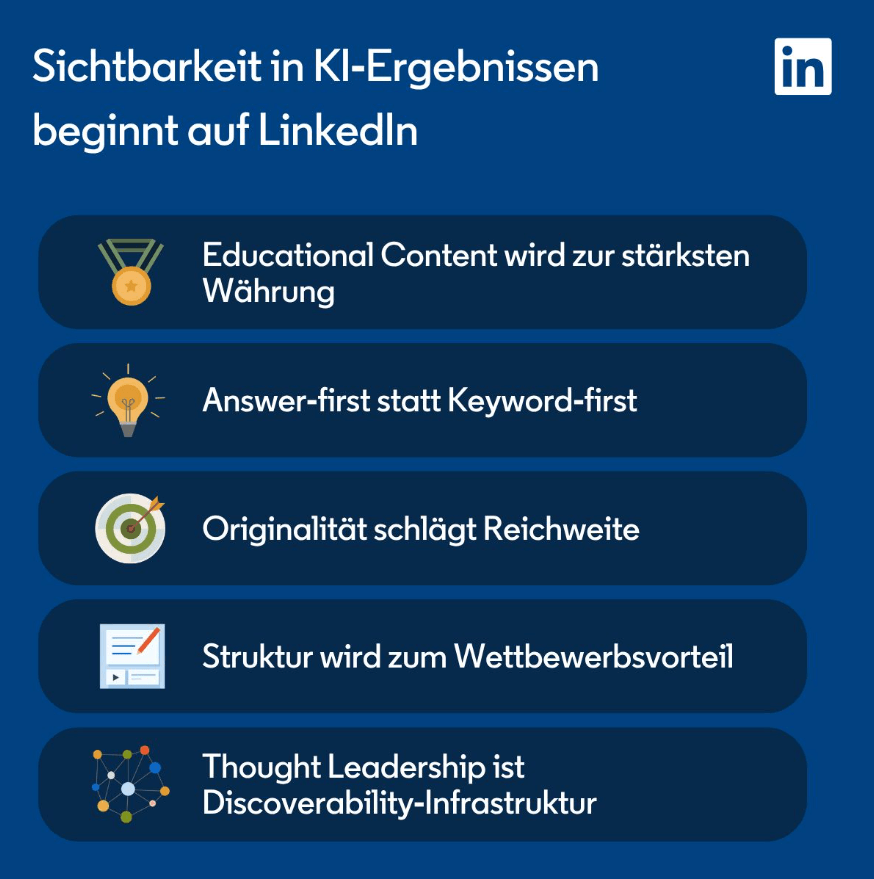
AI search visibility differs from a search ranking. An answer engine builds its response from several sources at once, so several people can each shape part of how your category is explained.
A group of credible experts gives an engine more sources to draw on than a single company page.
Four findings the research agrees on
Three studies and LinkedIn’s own guidance from March 2026 agree on four findings.
- Individuals over pages. Meltwater put the split at roughly 75% individual profiles to 25% company pages. Semrush found the pattern varies by engine: Perplexity cited company pages most often, while ChatGPT Search and Google AI Mode leaned towards individual creators.
- Original over plain resharing. Semrush found around 95% of citations came from original posts, and what separates an original post from a reshare is whether the employee added anything of their own. LinkedIn’s guidance says the same thing in its own words, recommending fresh original posts and articles.
- Explaining over promoting. Semrush found that most cited posts were sharing knowledge or practical advice. LinkedIn names educational content as the first of its three pillars.
- Depth carries weight. LinkedIn’s internal data says 60% of citations come from long-form articles, newsletters and posts, and its guidance suggests roughly 800 to 1,200 words for an article.
Semrush also measured how closely an AI answer copies the wording of its source. LinkedIn scored between 0.57 and 0.60, higher than Reddit or Quora. In plain terms, when an answer engine uses a LinkedIn post, more of the post’s own words survive into the answer. That is what makes an LLM citation from LinkedIn worth more than a passing mention.
Small accounts get cited too
We said in March that authors do not need a big audience to be cited. Research published since confirms it, with one nuance.
- LinkedIn’s internal data says members with 3,000 followers or more are more likely to be cited, and that posts with 10 or more comments are easier to find.
- Meltwater found that 51% of citations came from members with fewer than 10,000 followers.
- Semrush found the median cited post carried only 15 to 25 reactions and no more than one comment.
The findings measure different things. LinkedIn is describing a pattern across its whole member base. Meltwater and Semrush looked at where cited content actually came from, and most of it came from people without big followings, on posts that were never especially popular.
So a bigger following probably helps a little. It is not a requirement, and a marketing team cannot directly control it, so it is a poor target.
The four things the research agrees on are all within a programme’s control: whether posts are original, whether they explain something, whether they come from a named expert, and whether they are published regularly. This is the long tail of expertise in practice, and it is why employee advocacy works for AI search.
Multiple employee voices corroborate each other
Employee advocacy used to be justified by reach. Marketing makes something, employees share it, more people see it.
LinkedIn makes that case itself. Dave Yang, who leads LinkedIn Marketing Solutions across APAC, puts employee posts at roughly 12 times the reach of a company pageLinkedInDave Yang, Head of APAC, LinkedIn Marketing Solutions: In 30, B2B marketing insights (2026)Opens in a new tab.
The reach case still holds. For AI search, sharing alone falls short. A plain reshare contributes no words of the employee’s own, so it gives an engine nothing new to read, attribute or cite. The research is clear that original posts are what get cited.
Answer engines also look for sources that independently corroborate each other.
One company saying it is good at identity management is a marketing claim. Compare that with three people. An engineer explains a technical trade-off. A customer success lead answers a question that keeps coming up in rollouts. A founder describes where the category is heading. Their accounts agree, and they come from three separate, named sources.
The second is far more useful to an answer engine.
An advocacy programme should therefore produce many different accounts of the same expertise, each credible on its own.
LinkedIn’s own marketing leadership describes the same effect, and points to executives and employees as the people who add credibility a company page cannot.
“The more you show up around the same themes, the stronger those signals become.”
Aim for one consistent position, expressed in different words by each person.
How to set up advocacy for AI citations
The four agreed signals translate into four operating decisions. Here is how we have built Heyoo to support each one.
1. Make the default output an original post with the employee’s own input.
This has the biggest effect, and it comes down to workflow. If the easiest thing an employee can do is hit share and add nothing, that is what most of them will do. If it is a draft already written from their point of view, you will get original posts instead.
In Heyoo, marketing defines a campaign with an objective, source material, employee groups and any visuals. Each employee then receives three personalised post suggestions written in their own tone of voice, which they can pick from, edit or rewrite before publishing. One campaign produces many different original posts.
See how Heyoo’s Advocacy Campaigns turn one brief into personalised post drafts2. Keep each person’s own voice.
If 75% of LinkedIn citations come from individual profiles, posts need to sound like the person who wrote them. Company copy under someone’s name loses that credibility. Heyoo builds a personal tone of voice profile for each person, from their own LinkedIn examples, a quick style wizard or a template, and writes every suggestion against it.
LinkedIn also advises publishing authentic content rather than fully AI-generated text, and says this helps avoid being flagged or blocked from indexing. Heyoo’s suggestions give each person a starting point, and the Heyoo editor nudges them to add their own perspective before publishing. Monthly content interviews, part of the content strategy, collect each person’s experience and opinions first, so the expertise in every post comes from the person whose name is on it.
3. Match the topic to the person who knows it.
Many companies push every message through the most senior person available. The research suggests relevant expertise outweighs seniority, which means a security question is often strongest from an engineer and an implementation question from customer success.
Campaigns and sources in Heyoo can be assigned to specific employee groups, so the right topics reach the right people. For executives and senior experts, Managed Profiles lets marketing prepare drafts, run approvals and coordinate scheduling while the leader keeps final say. Leaders who do not want to write can submit notes, bullet points or a voice recording instead.
Explore Managed Profiles for executive and expert thought leadership4. Keep posting regularly.
LinkedIn suggests posting two to three times a week, or at least weekly. Most teams struggle to sustain that, usually because nobody has time to find relevant material and brief each colleague on it.
The Heyoo Content Agent helps with this. Marketing picks the sources worth watching, such as the company blog, industry publications, RSS feeds and relevant LinkedIn Pages. You then set which employee groups each source is for. Heyoo monitors them and turns relevant developments into campaign inspiration for admins or personalised post ideas for employees. Marketing still decides which advocacy campaigns go live, and employees still decide what they publish.
Volume without substance does not help. We wrote separately about avoiding the low-effort AI content LinkedIn is moving against, and the same logic applies here. More posts that explain nothing will not produce citations.
Measure participation and output
Engagement is a very good indicator, and for AI search performance it tells only part of the story.
Semrush found the median cited post had 15 to 25 reactions. A post can do modestly in the feed and still shape an answer. Engagement and citation each show something the other misses, so track both.
So measure the programme itself.
Who is participating, what is being published, how often, and what it drives. Heyoo’s LinkedIn analytics compare authors, topics and formats and attribute clicks and website traffic per employee and per campaign. This tells you whether the four operating decisions above are actually happening.
It also shows which of your experts are publishing on which topics, in their own words.
The expertise is already inside the company
Most of what an answer engine would find useful about your market already exists inside your organisation. Sales hears the objections. Customer success hears the implementation questions. Product knows the trade-offs buyers never see from outside.
Little of it is published where an AI engine can read it.
What gets cited is a named person explaining something they genuinely know, in their own words, more than once. It is most valuable when it is something only your company has: the research you have run, the projects you have delivered, the numbers in your own data, the questions your customers keep asking. Answer engines cannot find that material anywhere else.
Employee advocacy builds reach, and it also puts a company’s knowledge into the AI tools buyers consult.
Any team can act on the four things the research agrees on, whatever its follower counts.
Book a 30-minute demo to see how Heyoo runs employee advocacy at scale
 Open in Claude