













New in Heyoo: Knowledge Base

Every company knows things nobody else can publish: its own research, product details, customer insights, methodologies and the terminology its teams use every day.
Very little of that knowledge makes it into employee advocacy and thought leadership on LinkedIn. It sits in reports, presentations and internal guides, or in the heads of a few people.
With the new Knowledge Base, you can bring that context into Heyoo. Heyoo then uses the relevant parts when it creates post suggestions and drafts for your team, so every suggestion starts from a stronger factual base.
Employees, executives and subject matter experts then add their own perspective, experience and tone of voice.
Why we built this
Every company has knowledge that should make its way into its LinkedIn content.
That knowledge is usually scattered. Product details live in documentation, research findings in reports, customer insights in presentations and terminology in internal guides. Proprietary data, benchmarks and frameworks may only be known by a few people.
When an employee sits down to write a post, none of this is at hand. Finding the right figure or the correct product description takes time, so posts tend to stay general.
The Knowledge Base brings this context into Heyoo and makes it available at the moment content is created.
Often the most valuable input is knowledge only your company has: its own research, survey results, benchmarks, customer insights, product data, methodologies or learnings from the team’s real work.
One of the key reasons we built this is AI search visibility.
Cited LinkedIn content is often original, educational and specific, with concrete details and data showing up frequently. That is the pattern in Semrush’s study of 89,000 cited LinkedIn URLsSemrushSemrush: We analysed 89K LinkedIn URLs cited in AI search (2026-03-10)Opens in a new tab, and LinkedIn’s own guidance on AI visibility draws on the same data when it describes what gets content cited:
“The secret sauce is to frequently craft and share high-quality, insightful content that showcases your expertise or firsthand experience through unique angles, data, and information about your industry, brand, products, and services.”
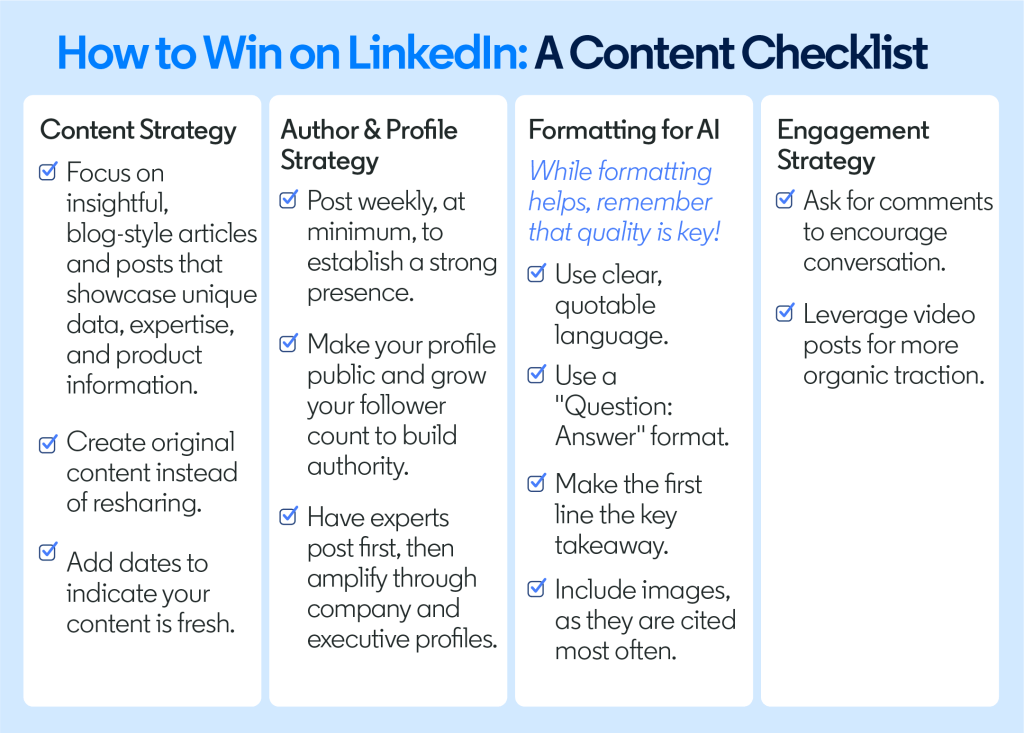
Data, industry knowledge and information about your products and services are exactly what the Knowledge Base holds. Knowledge that only your company has gives your employees and experts something valuable to contribute, and the Knowledge Base puts it in front of them every time they write.
What’s new exactly?
The Knowledge Base has two parts: Company knowledge and Languages.
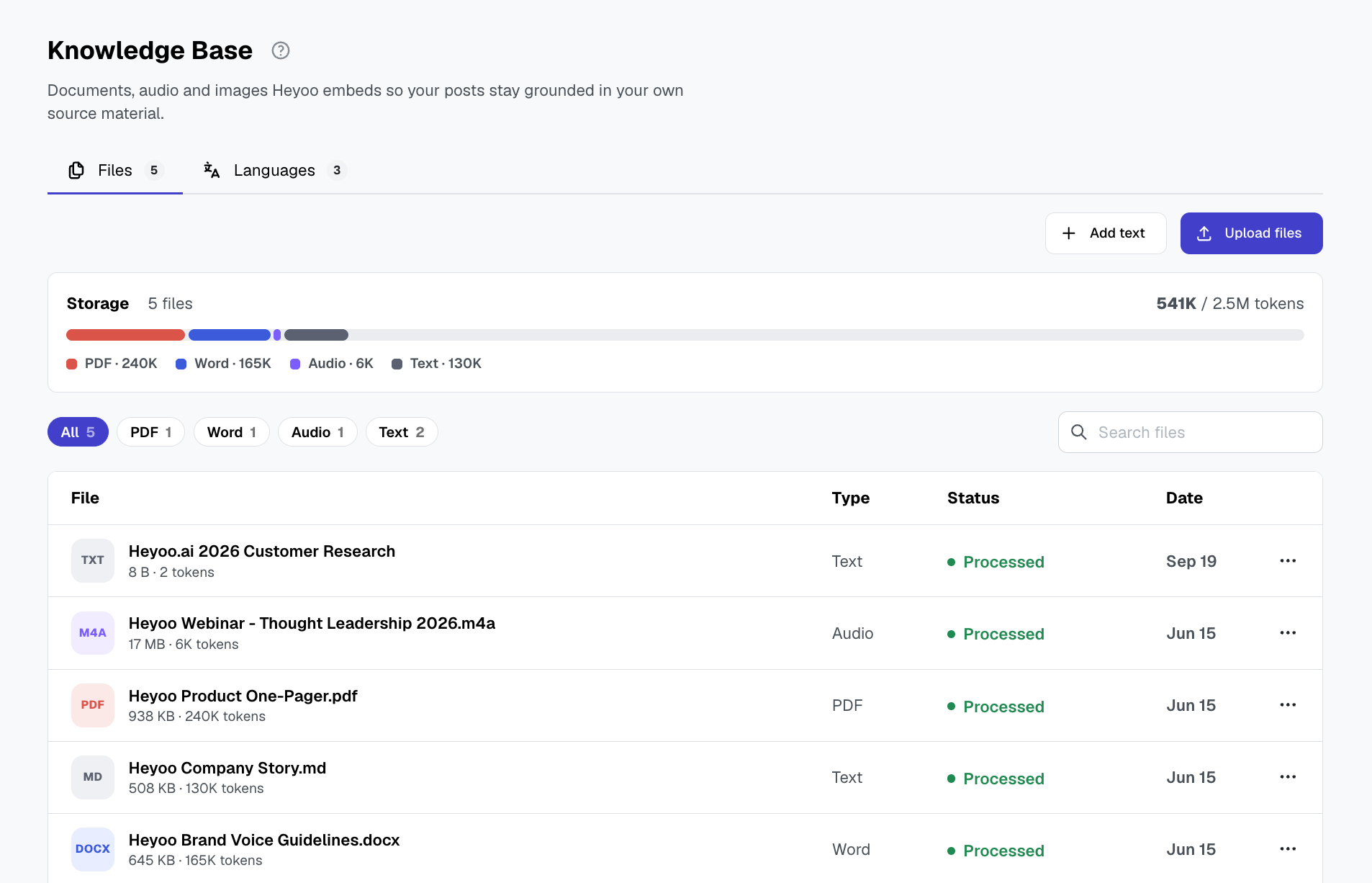
Company knowledge is a central source of company context for Heyoo. You can add:
- Product and service information
- Product names and descriptions
- Research, proprietary data and benchmarks
- Customer insights and methodologies
- Industry knowledge
- Company positioning and stories
- Internal terminology and abbreviations
- Presentations, internal documents and other relevant company material
You can upload files such as .pdf, .md and .docx documents, audio and video, or add information directly as text. Heyoo uses the relevant information from here when it creates employee post suggestions and post drafts.
Languages keeps company terminology correct and consistent across languages. Admins can:
- Add company specific terms
- Define the preferred translation for each language
- Add additional languages
- Mark terms as Keep as-is when they should stay unchanged
- Manage terminology centrally across the workspace
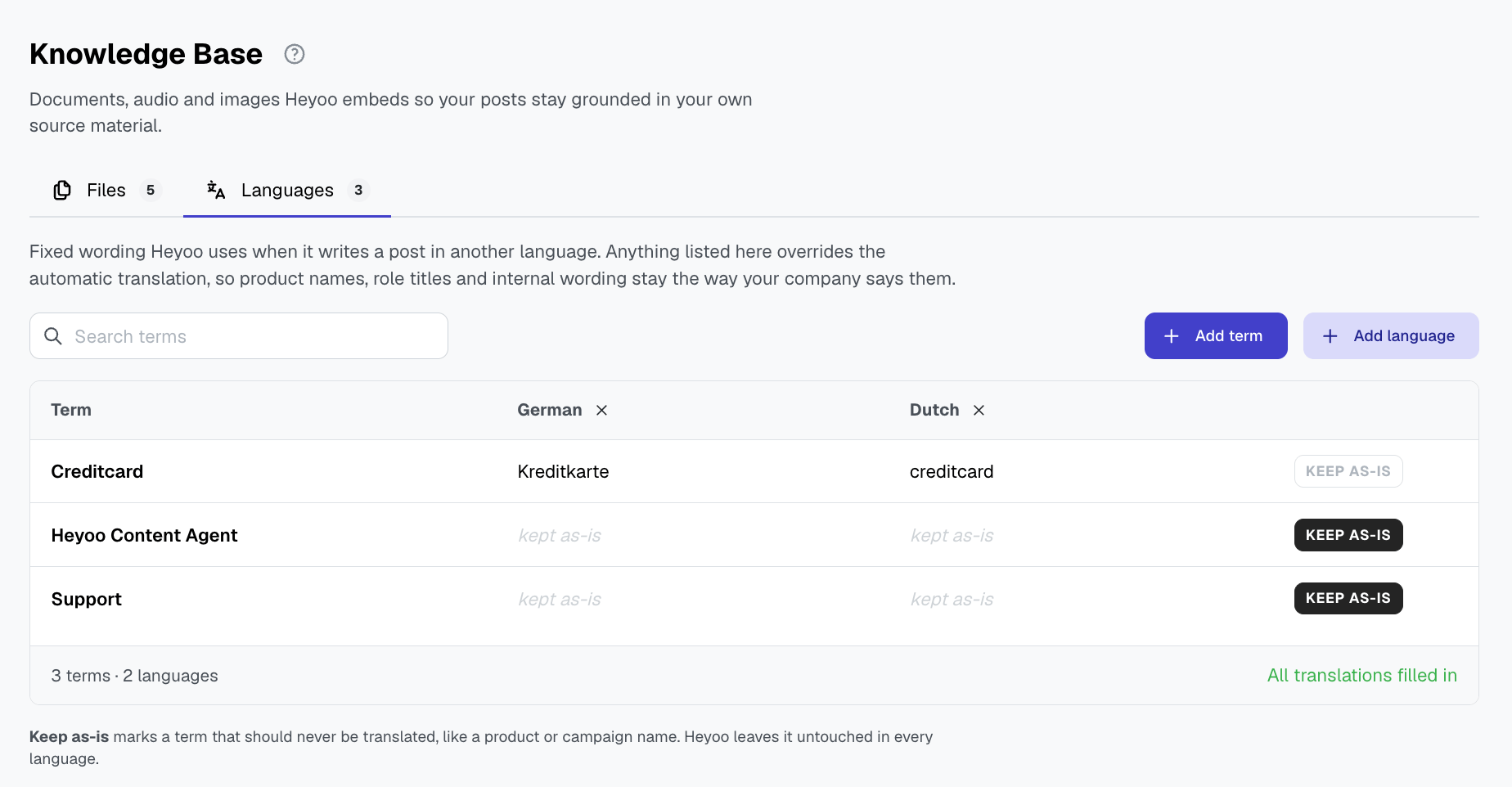
This is especially useful for product names, technical terms, abbreviations and any other wording that has to stay accurate in every language your team posts in.
How does this work in Heyoo?
The Knowledge Base has two tabs under Settings:
Under Files, add the company knowledge and context Heyoo should use when creating content. Heyoo then pulls relevant information from those sources into employee post suggestions and post drafts.
Under Languages, define how important terms should be written in each language, or mark the terms that should never change.
The result is more specific, better informed LinkedIn content based on what your company actually knows.
What this looks like in practice
Your company ran an industry survey.
Add the report to the Knowledge Base. When someone on your team writes about that topic, Heyoo can bring the relevant findings and data points into their post suggestions, so the post quotes the actual numbers from your research.
Your team has its own methodology or product terminology.
Add it, and post suggestions reflect the actual framework, facts and language your company uses. A consultant writing about your approach gets the steps of your methodology, named the way your team names them.
Your product names have to stay identical in every language.
Mark them as Keep as-is under Languages. Posts in every language your team uses then carry the same product name, spelled the same way.
Why company knowledge helps your AI search visibility on LinkedIn
AI answer engines such as ChatGPT, Perplexity and Google AI Mode already draw on LinkedIn when they answer professional questions. Profound ranks LinkedInProfoundProfound: LinkedIn is the most-cited domain for professional queries in AI search (2026-03-09)Opens in a new tab as the most-cited domain for professional queries across six AI platforms. That makes the posts your employees and experts publish part of how engines describe your company and your category, which is the core of AI search visibility.
Research into which LinkedIn content gets cited keeps pointing to the same three qualities. Cited content tends to be original, educational and specific.
Original.
Semrush analysed 89,000 LinkedIn URLs cited across ChatGPT Search, Google AI Mode and Perplexity. Around 95% of citations traced back to original posts, according to Semrush’s study of cited LinkedIn URLsSemrushSemrush: We analysed 89K LinkedIn URLs cited in AI search (2026-03-10)Opens in a new tab. Plain reshares made up the remaining 5% or so.
Educational.
In the same dataset, between 54% and 64% of cited LinkedIn content was knowledge-driven or advice-driven, depending on the engine. Content promoting a product came some way behind.
Specific.
LinkedIn’s content checklist for AI visibility, shown above, opens with posts that “showcase unique data, expertise, and product information”. Its guidance also advises to “give as much detail as you can, but make it easy to digest”. Concrete detail is what gives an engine something to quote, and each quote is an LLM citation pointing back to the person who wrote it.
Put together, the raw material for a cited post is data, product and industry information, and first-hand expertise. Most companies already have all of it. Very little of it reaches the employees and experts who post on LinkedIn.
Company knowledge plus individual perspective
The Knowledge Base closes that gap. When a subject matter expert opens a post suggestion, the survey figure, the product detail or the correct name for your methodology is already there.
The expert then adds what only they can: their own experience, a customer conversation, a lesson from a project or a view on where the market is heading. That combination is what the research describes. Company data makes the post specific. The individual perspective makes it original.
Each suggestion is still written in the employee’s personal tone of voice, so a team drawing on the same Knowledge Base still sounds like a group of different people.
Consistent terminology helps as well. Semrush found that precise, consistent terminology reduces the chance of an AI answer paraphrasing a source into something it did not mean. The Languages section keeps product names and key terms identical across every post and every language, so engines read the same name for the same thing, whichever colleague wrote the post.
Across a whole team, every specific, well-informed post adds to your company’s long tail of expertise: many named experts, each answering a narrower question with detail an engine can use.
See how Heyoo’s Tone of Voice AI keeps company facts in each employee’s own voiceCompany knowledge, ready for the whole team
Company knowledge should be easy for the whole team to use as part of your AI visibility strategy. With the Knowledge Base, it sits in the same place where your team already creates LinkedIn content.
Marketing adds the research, product information and terminology once. Every employee post suggestion then starts from it, and every employee adds the perspective only they have.
Book a demo to see the Knowledge Base in action
 Open in Claude