
















How to Write Cite-Worthy LinkedIn Posts for AI Search Visibility


TL;DR: Quick summary
Semrush, Profound and Meltwater have each studied which LinkedIn content AI answer engines cite, and LinkedIn has published its own guidance. We read all of it and combined the findings into one read. Six rules come out of it.
- Open with the answer. LinkedIn builds a post’s URL from its first line, and that URL is fixed the moment you publish.
- Structure posts as questions and answers. Between 54% and 64% of cited posts share knowledge or practical advice, according to Semrush.
- Keep to the cited length ranges. Semrush found feed posts of 50 to 299 words take the largest share of post citations, and articles of 500 to 2,000 words the largest share overall.
- Write original posts. Roughly 95% of cited posts are original. Reshares account for about 5%.
- Post frequently. Around three quarters of cited post authors had published five or more posts in the previous four weeks.
- Do not judge posts only by reactions. Engagement is a very good indicator, though the median cited post carried just 15 to 25 reactions.
The sources are Semrush’s study of 89,000 cited LinkedIn URLs, Profound’s citation tracking, Meltwater’s analysis of 9.5 million AI citations, and three pieces of AI search guidance LinkedIn has published since March 2026. They agree on most points. Where they differ, the difference is noted below.
What the published research shows
There is now published data on which LinkedIn content AI engines cite. Three research teams have published analyses of what gets cited, and LinkedIn has issued guidance three times since March 2026. We covered the evidence that AI systems are already citing LinkedIn content when the first of that evidence was published.
Profound ranks LinkedIn as the most-cited domain for professional queries across six AI platforms. In Semrush’s dataset, spanning all query types rather than professional ones, LinkedIn comes second and appears in around 11% of AI responses. On either measure, AI search visibility on LinkedIn can be measured.
Profound also tracked what kind of LinkedIn content gets cited, and the mix moved fast between November 2025 and February 2026. Citations of static profiles fell from 33.9% to 14.5%. Feed posts rose from 20.9% to 26.0%, and long-form articles from 6.0% to 8.9%.
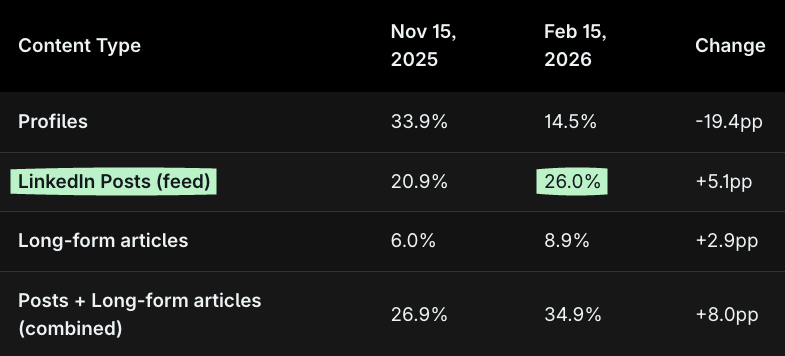
The shift is away from static profile pages and towards recently published content.
Most published advice addresses one marketer writing one post. Inside a company, the relevant expertise sits with colleagues across departments, few of whom write for a living. Applying the research at that scale is a different problem.
What makes a LinkedIn post cite-worthy?
Semrush measured how closely an AI answer echoes the wording of the source it cites, on a scale from 0 to 1. LinkedIn scored between 0.57 and 0.60. Reddit came in at 0.53 to 0.54 and Quora at 0.435. When an engine uses a LinkedIn post, more of the post’s own language survives into the answer than it would from those platforms. That is what makes an LLM citation from LinkedIn worth more than a passing mention.
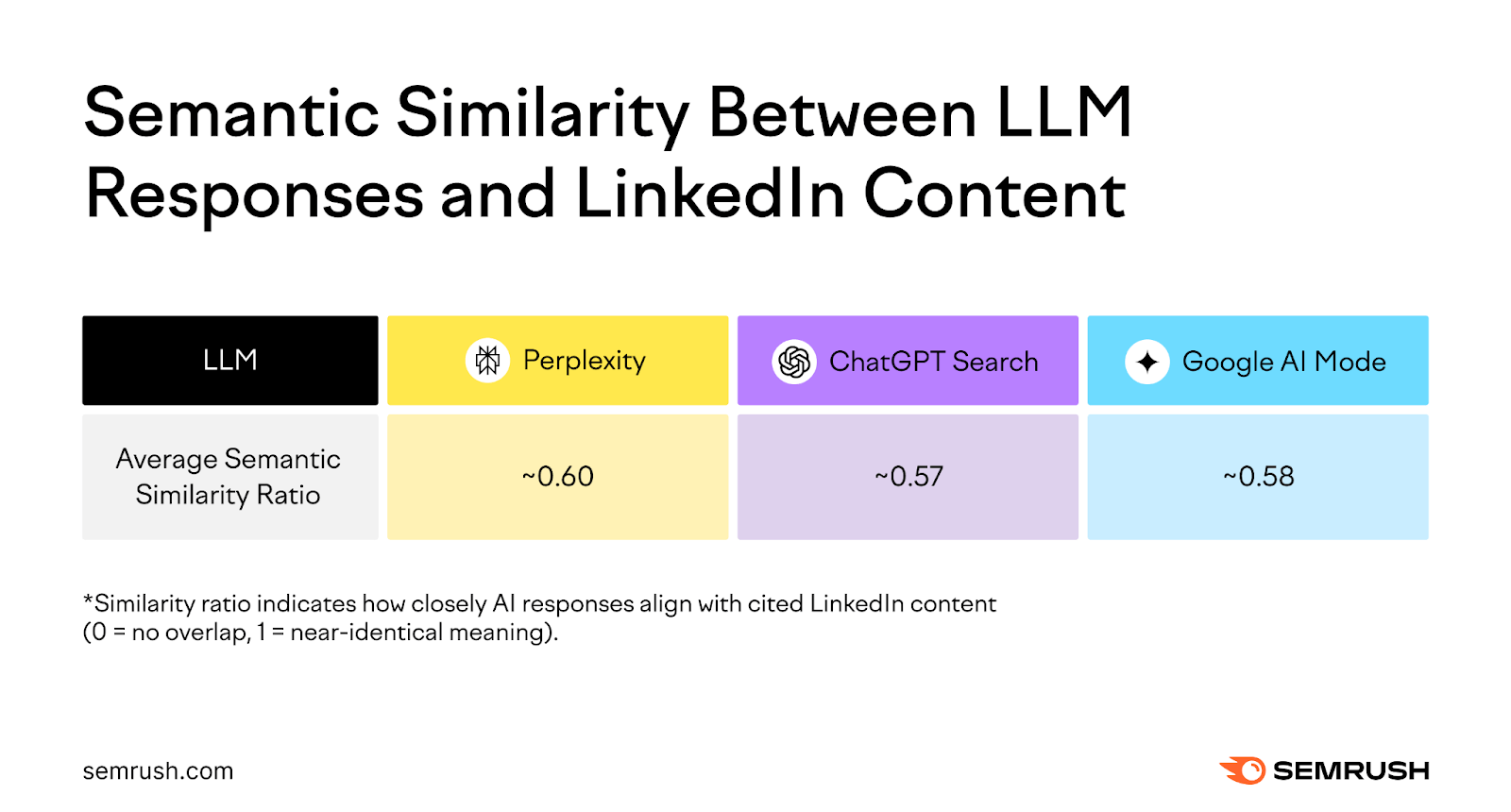
So write precisely. Vague phrasing tends to be paraphrased into something the author did not say. Precise phrasing tends to reach the answer largely intact.
LinkedIn adds a second mechanic in its August guidanceLinkedInLinkedIn Marketing Solutions: How B2B marketers can dominate AI search on LinkedIn (2026-08-11)Opens in a new tab. Answer engines assemble an answer from several sources, so a brand becomes far more likely to be cited when several credible voices cover the same theme from different angles. A single strong article is rarely sufficient on its own.
The six rules below govern the individual post. Coordinating them across a team is covered after that.
Rule 1: Put search keywords in the first line
LinkedIn generates a post’s URL slug from its opening line. The slug is created at publication and cannot be edited afterwards, however much you edit the post itself.
- Lead your first sentence with the words someone would actually search for.
- Keep hashtags out of the opening line. LinkedIn says they produce a generic URL and dilute the keyword signal.
- Watch attachments. If you attach a file, LinkedIn says the file’s name can become the URL instead of your first line.
- Check it before you publish, because you cannot change it after.
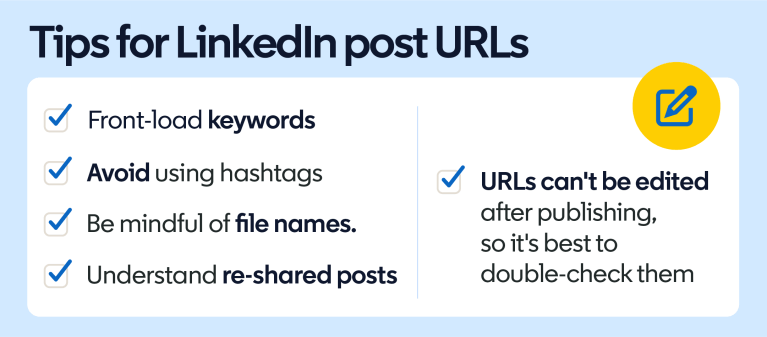
A post that opens with “Did you know LinkedIn articles account for 60% of AI citations?” produces a URL an engine can read. One that opens with a hashtag produces a URL that carries no keyword signal.
LinkedIn also advises leading with the most important information, because the first line of a post or the title of an article is what tends to get quoted.
Rule 2: Structure posts as questions and answers
LinkedIn recommends framing content as a question followed by its answer, and Semrush’s data supports it. Well over half of cited LinkedIn content is knowledge-driven or advice-driven, between 54% and 64% depending on the engine. Content promoting a product comes second, some way behind.
The question should be one the business has actually been asked. Sales hears these on calls, customer success during rollouts, and support on repeat. Those questions are already phrased the way a buyer would type them into an assistant.
Make the answer easy to extract.
- Use direct questions as subheadings, with one or two short sentences under each.
- Define your key terms rather than assuming them. Semrush found precise, consistent terminology reduces the chance of being paraphrased into something you did not mean.
- Use ranked lists and clear steps. Every top-cited LinkedIn article Meltwater measuredMeltwaterMeltwater: 9.5M AI citations analysed, how LinkedIn content wins AI search (2026-05-12)Opens in a new tab contained a bulleted or numbered list, and 92% used clear subheadings.
- Include specific dates, as in “the top AI tools for 2026”, so the timeline is legible.
- Add a short author biography at the end of longer pieces.
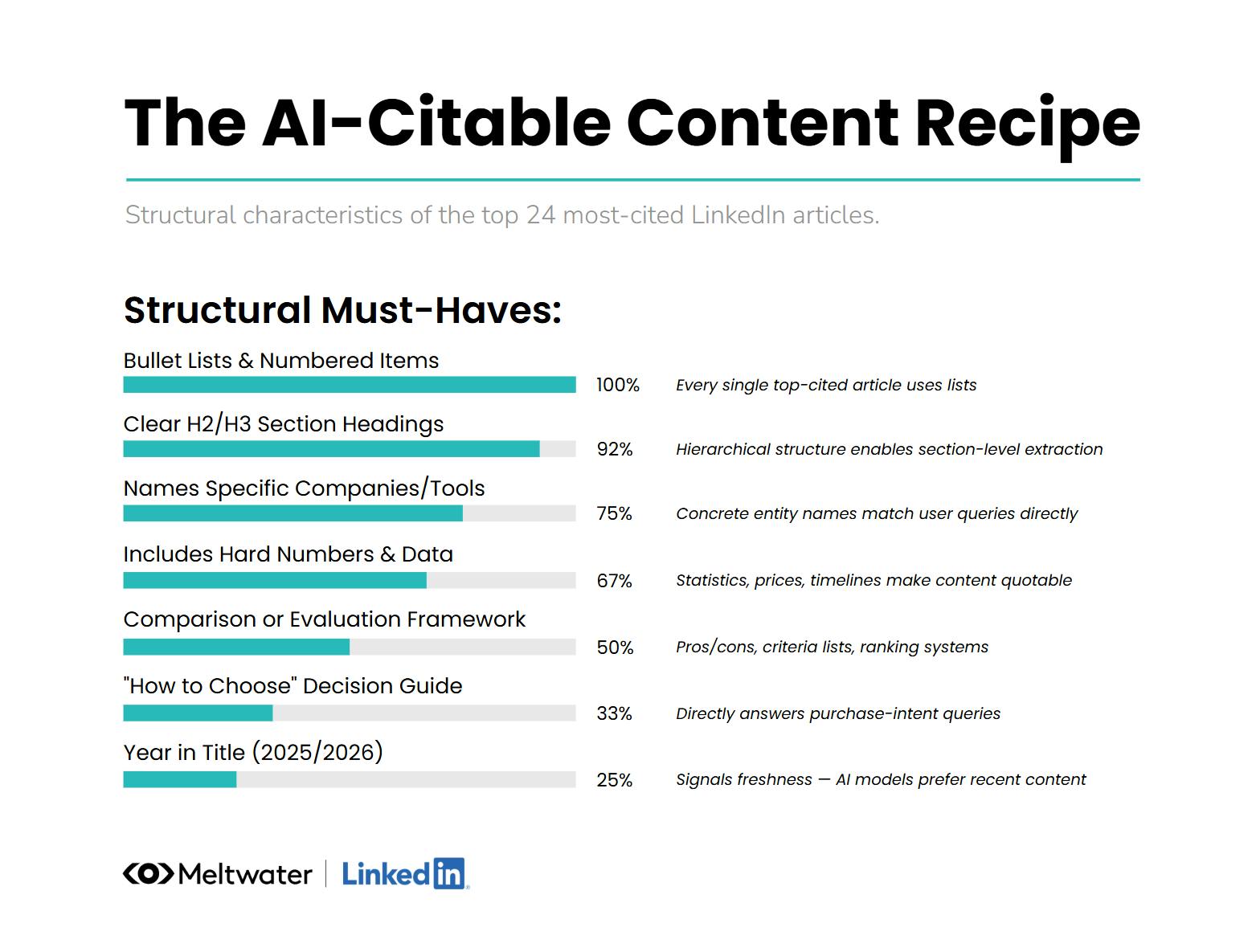
Structure alone is not enough. LinkedIn’s August guidance states that the content earning citations carries a point of view only its author could have written.
Rule 3: How long should a post be?
Semrush and LinkedIn give slightly different ranges.
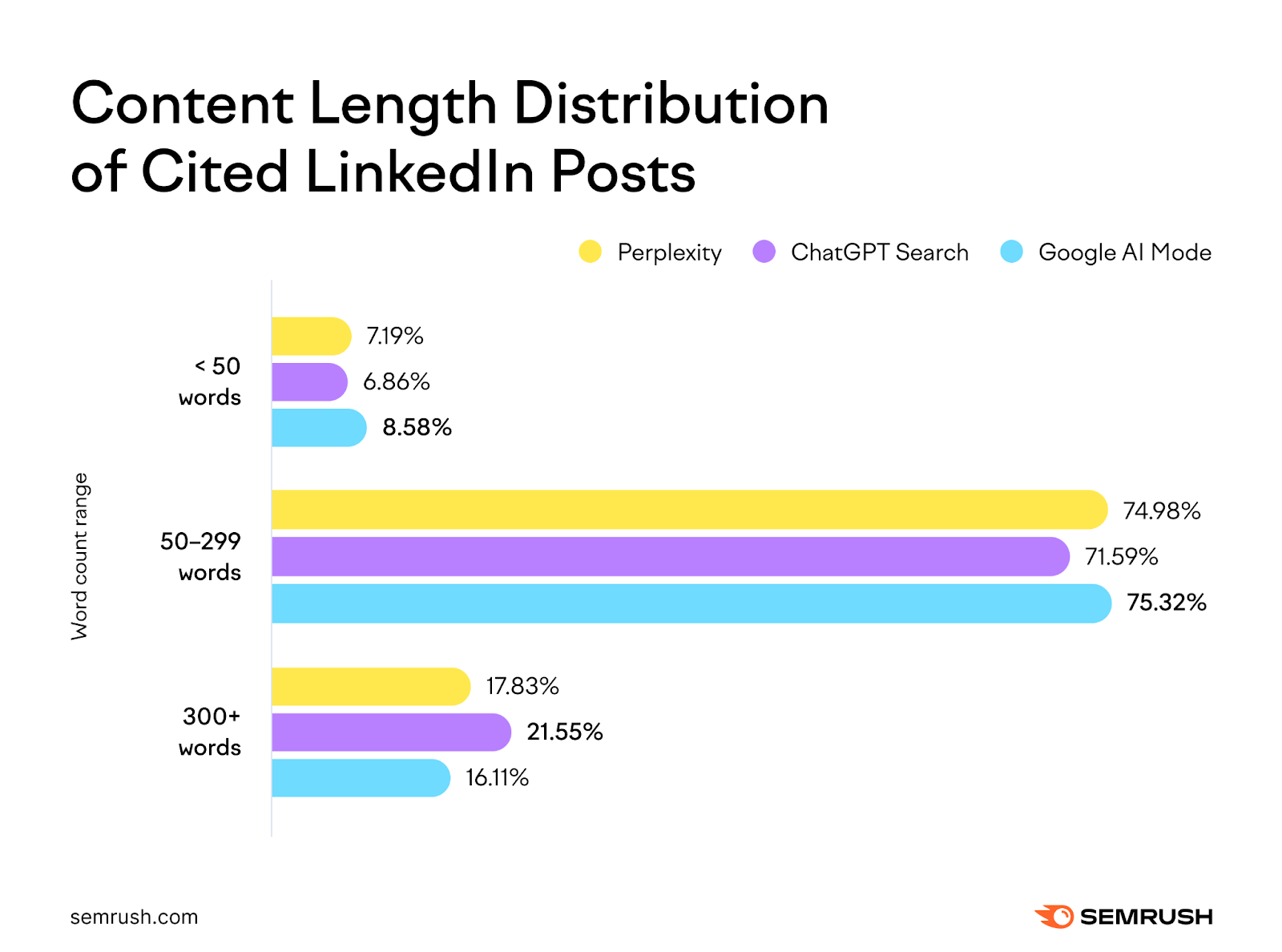
- Feed posts: Semrush found posts of 50 to 299 words take the largest share of post citations. LinkedIn narrows that to 200 to 300 words as its own recommendation.
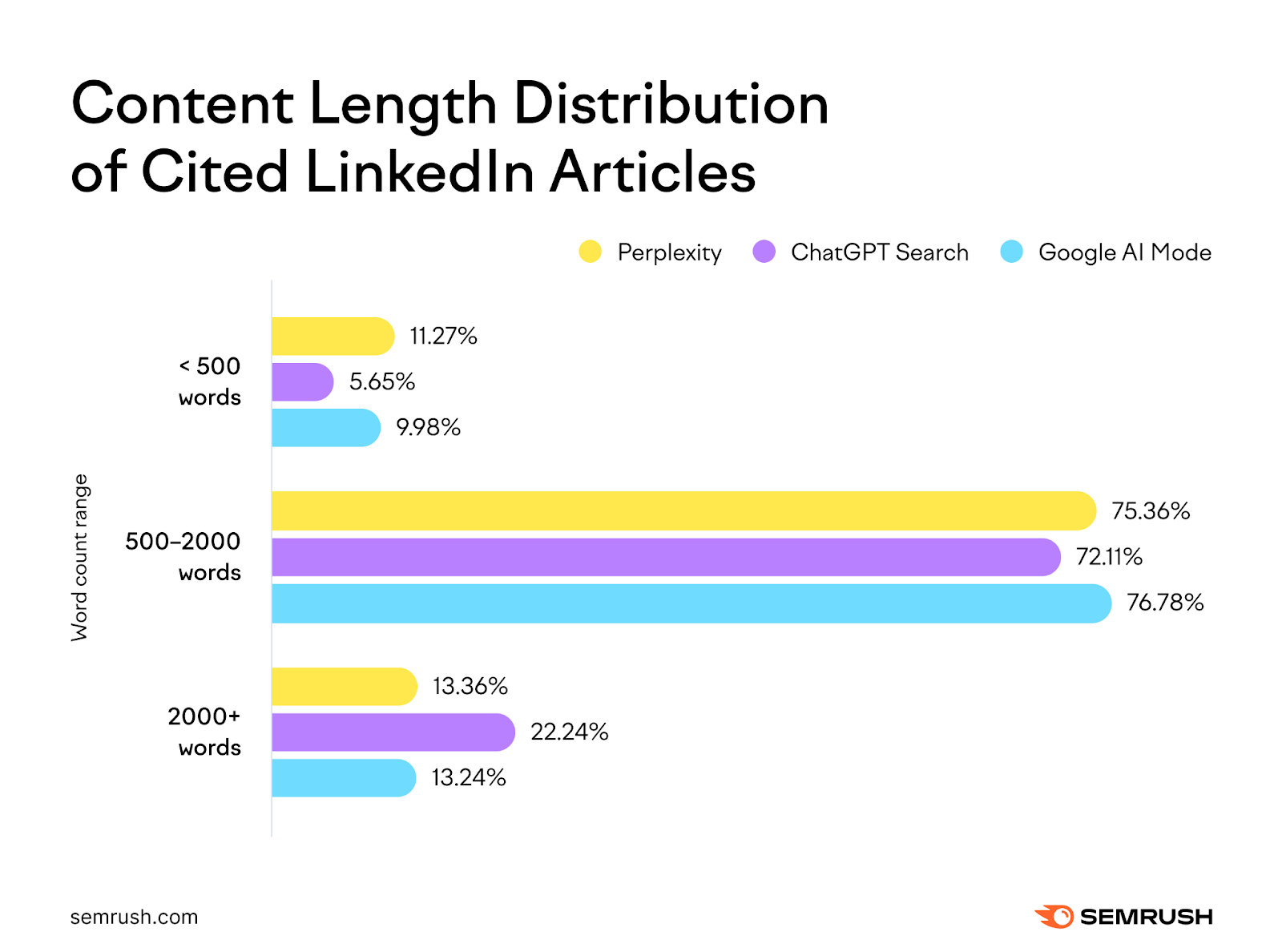
- Articles: Semrush found articles of 500 to 2,000 words cited most. LinkedIn’s early testing points at 800 to 1,200 words, which sits comfortably inside the observed range.
- The split between formats: articles account for roughly 60% of LinkedIn content citations and posts for the other 40%, according to LinkedIn’s August figures. Semrush observed articles at 50% to 66% and feed posts at 15% to 28%, varying by engine.
Articles carry more citations per piece. Posts are quicker to write and easier to sustain across a group of people who have other jobs. LinkedIn suggests running both, with one article and two to three posts a week.
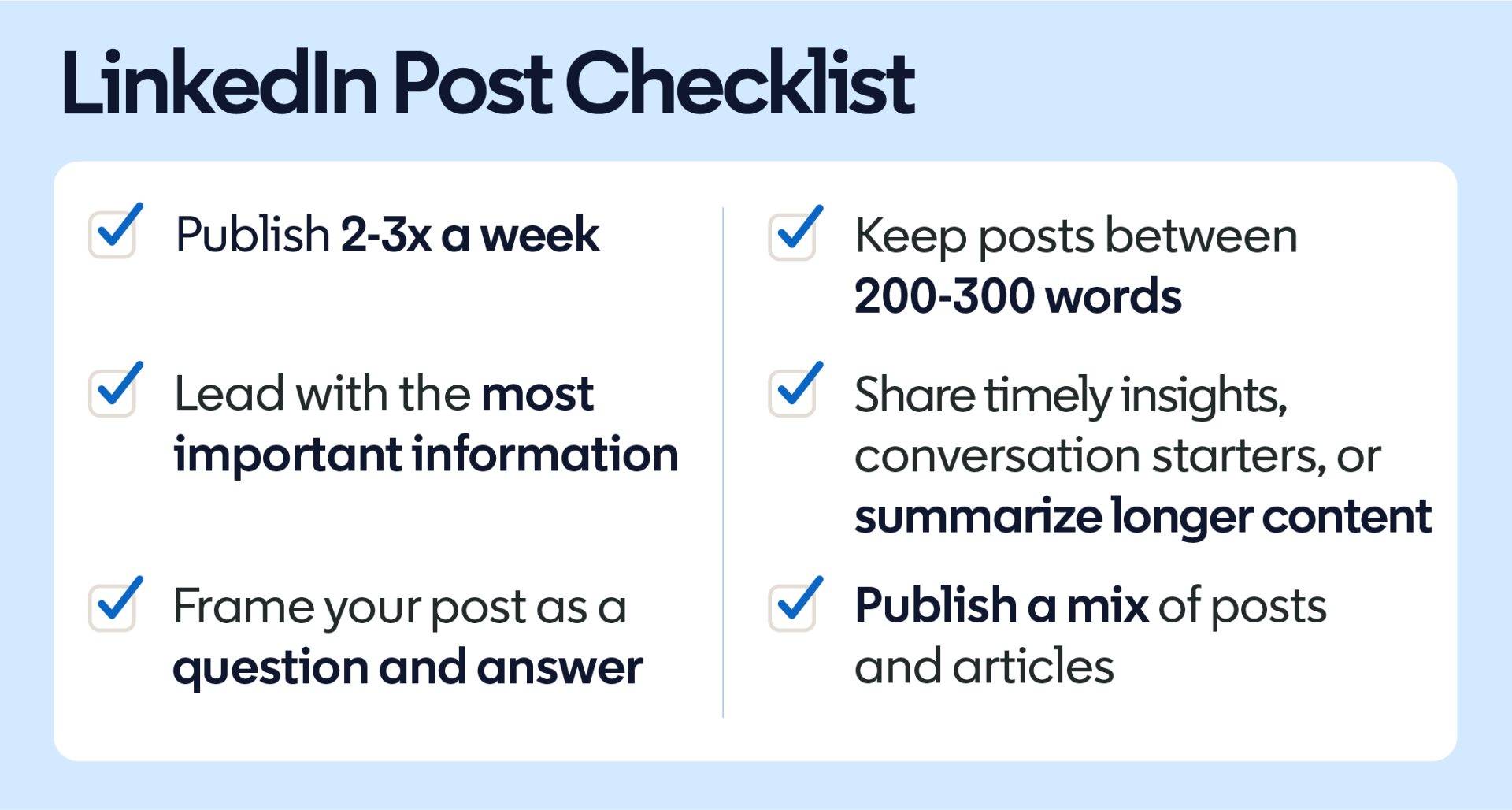
LinkedIn credits the 200 to 300 word figure to Semrush, but Semrush’s own published range is 50 to 299 words. That is the range the data supports.
Rule 4: Write original posts
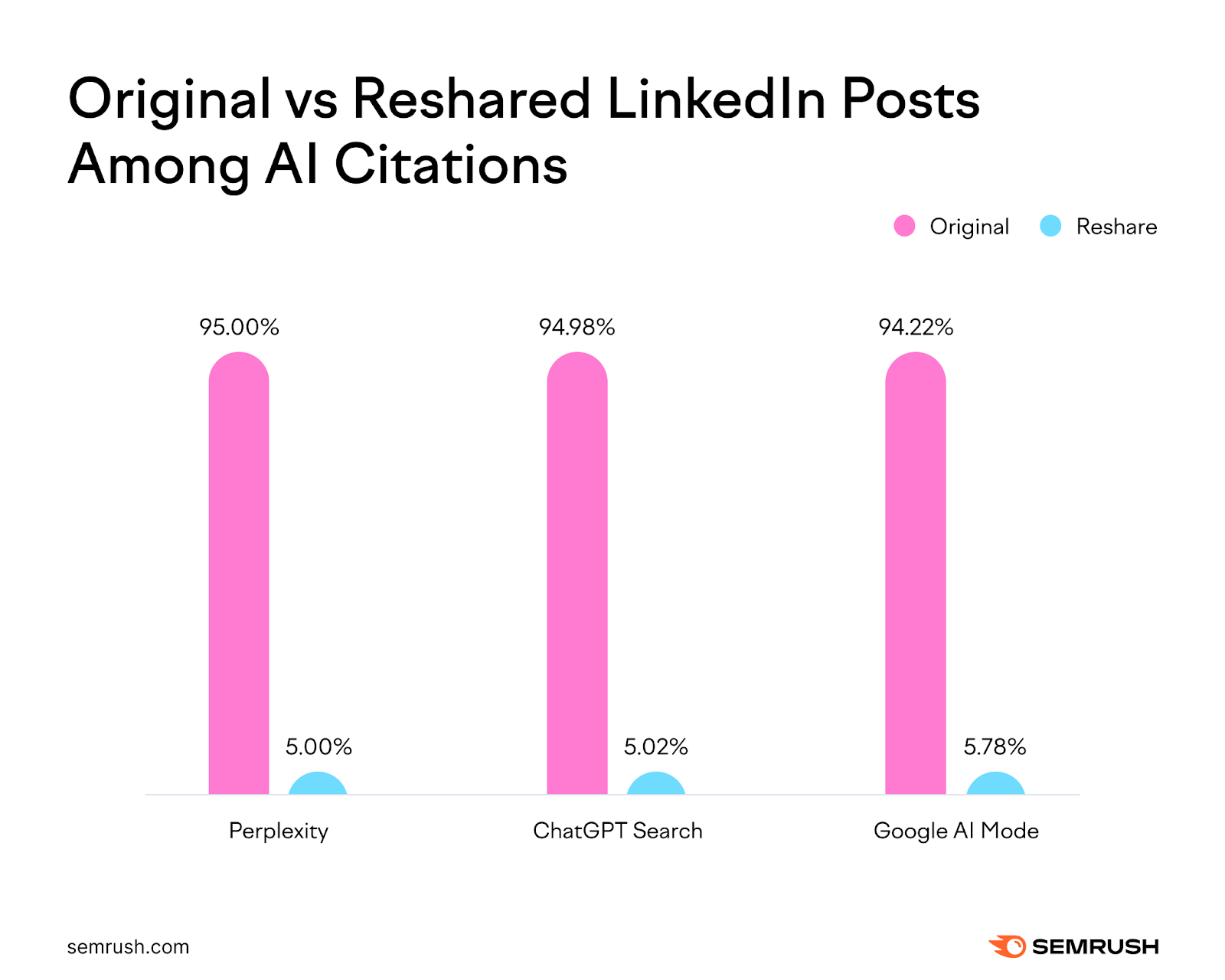
Semrush found that roughly 95% of cited LinkedIn posts were original. Reshares accounted for about 5%. The split is almost identical across all three engines.
The distinction is whether the post carries original wording. A colleague’s post forwarded untouched gives an engine nothing new to read or attribute. Adding two paragraphs of your own commentary turns it back into an original post.
Many advocacy programmes give employees only a share button. It adds reach, but contributes almost nothing to citation. We looked at the same problem from the programme side in our piece on employee advocacy and AI search visibility.
Rule 5: Publish frequently
Semrush found that around three quarters of cited post authors were frequent posters, meaning more than five posts in the previous four weeks. For long-form articles the figure was around 60%. Occasional contributors were cited far less often.
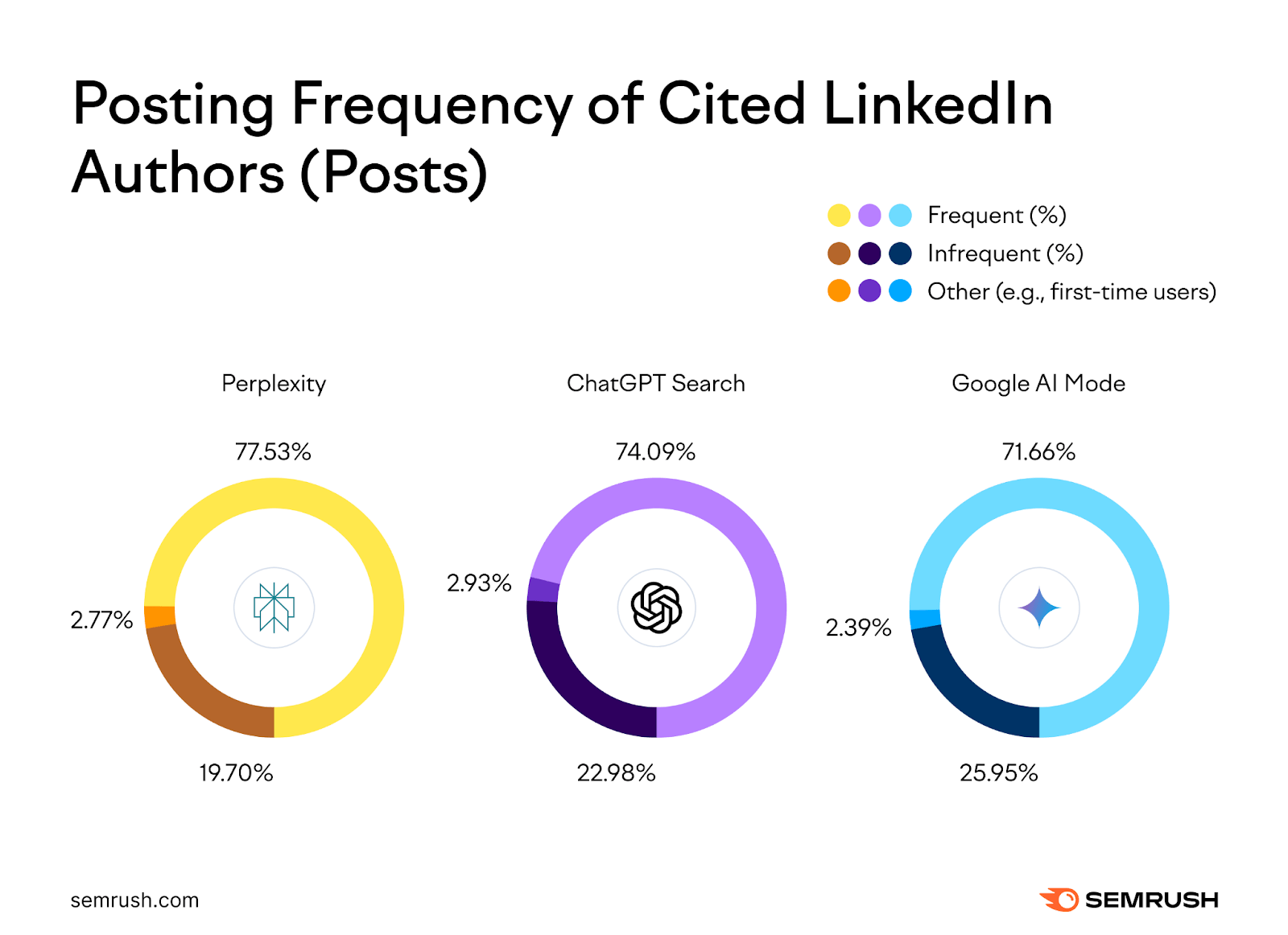
More published pieces give a retrieval system more chances to find one that answers the question.
LinkedIn’s own marketing leadership puts the weight on consistency rather than raw output.
“It’s about publishing the right content consistently. The goal is to build topical authority with AI systems.”
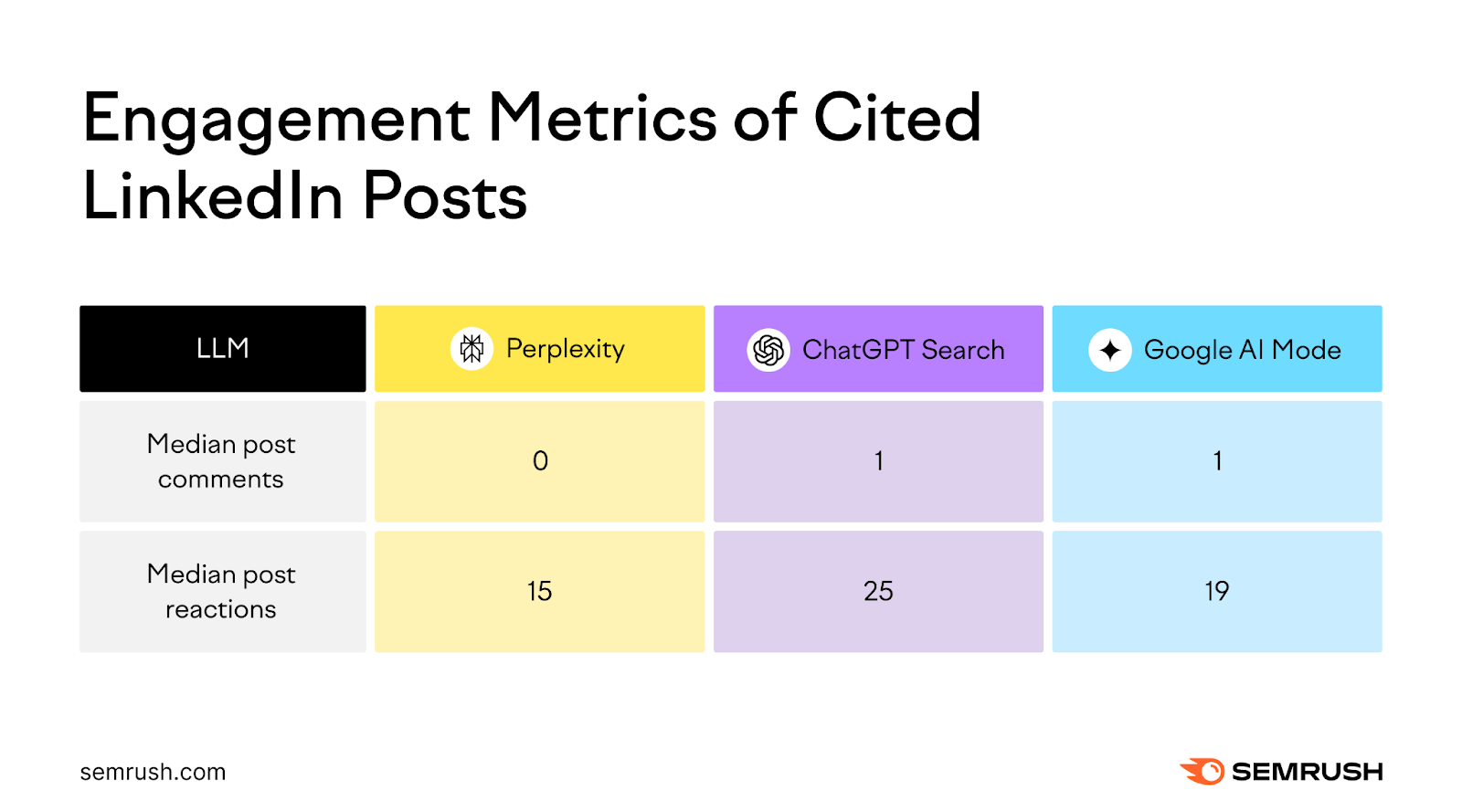
Most cited posts have low engagement.
The median cited LinkedIn post in Semrush’s dataset carried 15 to 25 reactions. A post with modest engagement can still shape how an engine explains a category. Engagement stays a very good indicator, and citation fills in the rest of the story. This pattern is known as the long tail of expertise.
Volume alone does not work. Posts that explain nothing will not produce citations, which is the argument we made in our piece on the low-effort AI content LinkedIn is moving against. LinkedIn’s own guidance says the same in its own words, advising authentic content over fully AI-generated text to avoid being flagged or blocked from indexing. Heyoo’s drafts are built as starting points for that: the Heyoo editor nudges each person to add their own perspective before publishing, and monthly content interviews, part of the content plan, collect their experience before a draft is written.
Rule 6: A large following helps, but is not required
LinkedIn changed its position on follower count twice in five months.
- March 2026: LinkedIn’s internal data put the threshold at 3,000 followers or more for a stronger likelihood of citation.
- June 2026: the figure became 2,000 or more, credited to Semrush rather than to internal data.
- August 2026: LinkedIn wrote that follower count is far less important than demonstrated expertise.
Semrush’s numbers show why. Nearly half of cited post authors had 2,000 followers or more, so an established audience helps. Small accounts were cited just as often.

“Individuals with less than 500 followers (beyond their connections) are just as likely to be cited, if not more so, than individuals with more than 500 followers.”
A larger following improves the odds slightly. It is not a prerequisite, and a marketing team cannot directly control it.
Unlike follower count, the other five rules are within a team’s control.
How do you apply this across a whole team?
In a company, the expertise sits with engineers, consultants and account directors who have other jobs. LinkedIn’s guidance covers this in a single bullet: “help employees post regularly on shared themes”.
Every post still needs the author’s own input and should reflect their own perspective. Their experience and their opinion give readers a reason to trust it, and set it apart from the low-effort AI text covered under rule five. Heyoo assists: it sparks ideas, helps each employee develop and write their own point of view, coordinates the programme and measures the results.
Heyoo handles this in four ways.
Make the default output an original post.
If the easiest available action is a share button, that is what most people will use, and rule four explains why it earns little. In Heyoo, marketing defines a campaign with an objective, source material, employee groups and any visuals. Each employee receives three personalised suggestions written from their own point of view, which they can pick from, edit or rewrite before publishing. One brief produces many different original posts.
See how Heyoo’s Advocacy Campaigns turn one brief into personalised post draftsKeep each person’s own voice.
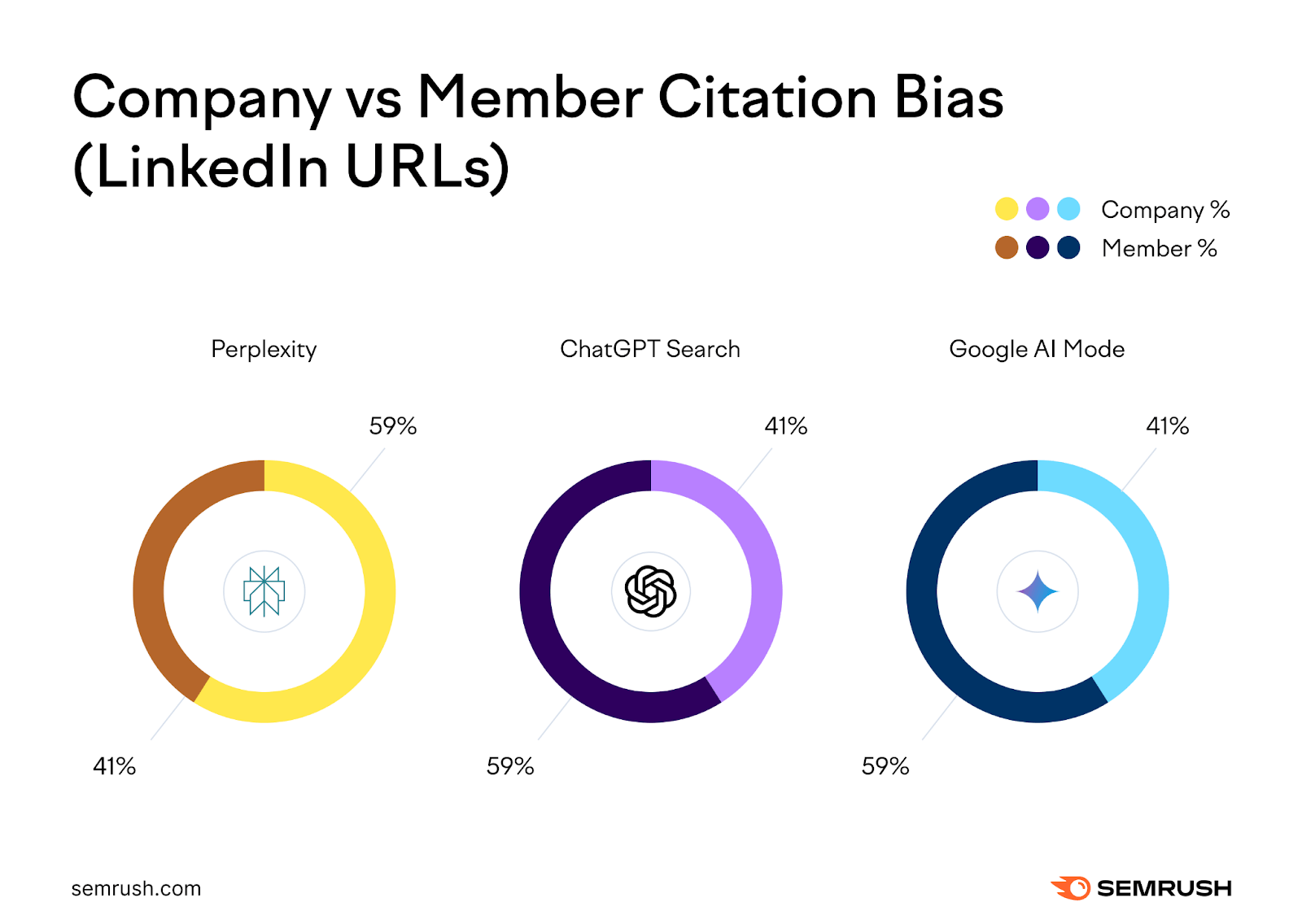
Semrush found the company-versus-individual split varies by engine. Perplexity took 59% of its LinkedIn citations from Company Pages, while ChatGPT Search and Google AI Mode took 59% from individual members. Posts that read like company copy under an individual’s name lose that credibility. Heyoo builds a personal tone of voice profile for each person, from their own LinkedIn examples, a short style wizard or a template, and writes every suggestion against it.
Match the topic to the person who knows it.
Many companies route every message through the most senior person available. The research favours relevant expertise instead: a security question carries most weight from an engineer, an implementation question from customer success. Campaigns and sources in Heyoo are assigned to specific employee groups. For executives and senior experts, Managed Profiles lets marketing prepare drafts, run approvals and coordinate scheduling while the leader keeps final say, including submitting notes or a voice recording instead of writing.
Keep posting through busy periods.
Rule five implies five posts in four weeks per person. Programmes usually fall short of that cadence because nobody has time to find relevant material and brief each colleague on it. The Heyoo Content Agent monitors the sources marketing picks, such as the company blog, industry publications, RSS feeds and relevant LinkedIn Pages, and turns relevant developments into campaign inspiration for admins or personalised post ideas for employees. Marketing still decides which campaigns go live. Employees still decide what they publish.
How do you know if it is working?
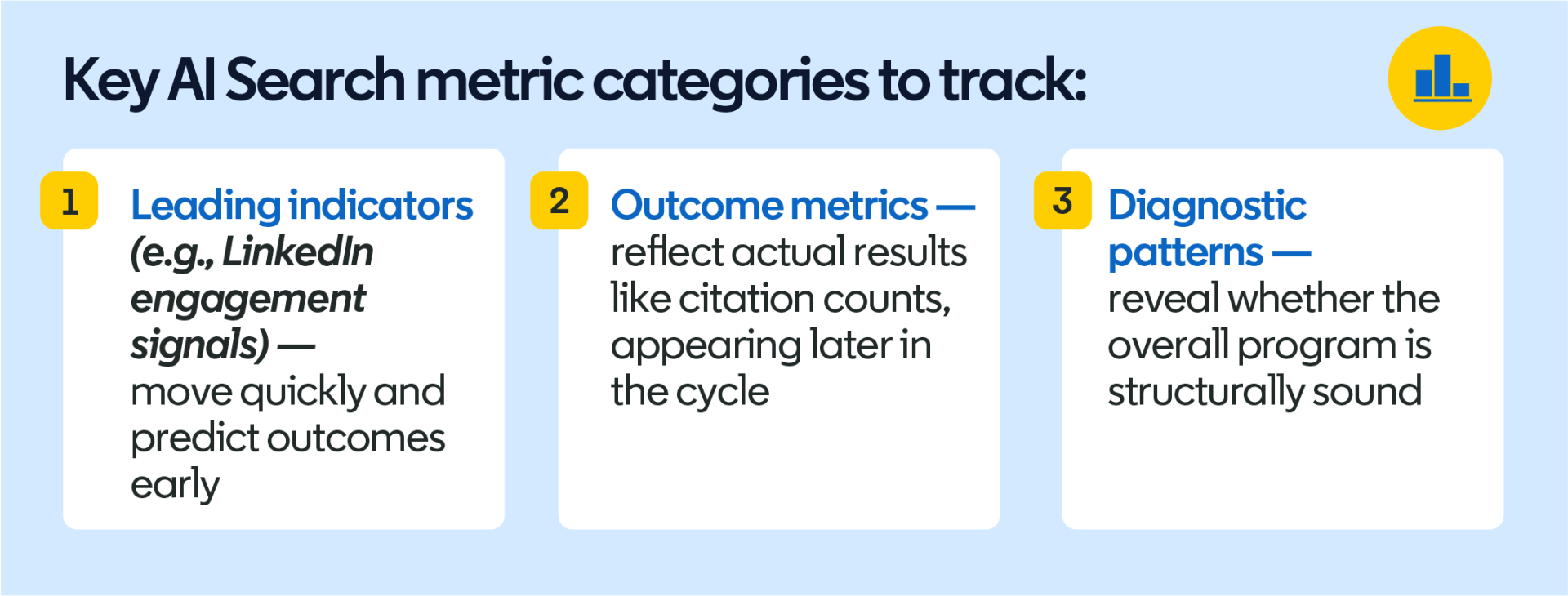
LinkedIn’s August guidance splits this into three tiers, and its warning is to keep them apart because they move at different speeds.
- Leading indicators move fast: impressions, reactions, comments and shares on LinkedIn.
- Outcome metrics move slowly: citation counts, share of voice, citation rank and sentiment inside AI answers.
- Diagnostic patterns explain the gap between them: which formats, which authors and which kinds of question are performing.
The middle tier needs a dedicated tool, and AI citation tracking is still a young category. The first and third tiers are things a programme can see today. Heyoo’s LinkedIn analytics compare authors, topics and formats and attribute clicks and website traffic per employee and per campaign.
Explore Heyoo’s LinkedIn analytics for author, topic and format reportingThis shows whether the six rules are being followed: which experts published what, on which topic, in their own words, and how often.
Putting the six rules into practice
The six rules cost little to follow. Lead with the answer. Ask a real question. Keep a post between 50 and 299 words. Add your own perspective. Publish weekly. Judge the result on reactions and citations together.
They need no large audience or budget. They need people with real knowledge writing four or five posts a month, and a programme that makes this easy.
Most companies already have this expertise, but little of it is published where an engine can read it.
The most valuable material is the part nobody else can publish: the research you ran, the projects you delivered, the numbers in your own data, the questions your customers keep asking. An answer engine has no other source for it.
Book a 30-minute demo to see how Heyoo runs employee advocacy at scale
 Open in Claude